
The Clinic That Knows Every Animal by Name: FaraERP Service Management for Veterinary Clinics and Hospitals
An owner arrives with three cats. The first is due a vaccination, the second was seen two weeks ago and the third has just come home from a hospital stay. If their records are mixed up under the owner’s name, nobody knows which cat got which medicine. In veterinary care the patient can’t talk — the record has to speak for it.
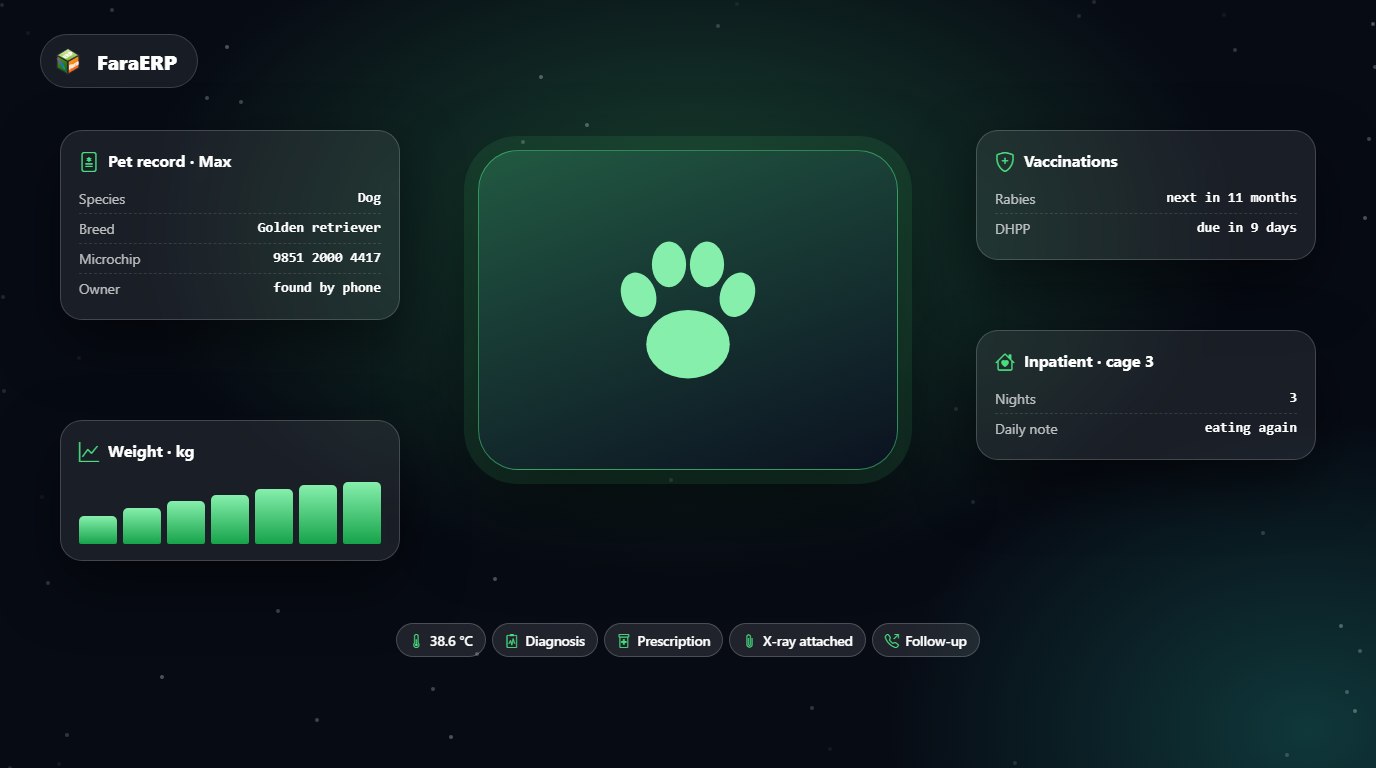
FaraERP’s service management has a dedicated veterinary profile: the owner is the client, and each animal has its own medical record, from its first visit to its latest vaccination.
At a glance
- Every animal with species, breed and microchip number, under its owner.
- A record per animal: weight, temperature, history, diagnosis, prescription, notes and files at every visit.
- A vaccination card with the next due date and a “due vaccinations” list.
- Inpatient care in cages or boxes, with daily notes and nightly stay charges.
- Follow-up after treatment and the next appointment in two clicks.
The owner is the client; the animal is the patient
Owners are found by phone number, and their animals — each with species, breed and microchip — are registered under their name. An admission is for the animal that came in today; two cats from one family never share a record. The reason for the visit and the symptoms go on the admission so the vet sees them before going in.
A record that speaks for the animal
- Every visit, structured: weight, body temperature, history, diagnosis, medication and prescription, and the vet’s notes.
- Files and images: an outside lab result or an X-ray is attached to that animal’s record.
- Vaccination card: vaccine name, date given and next due date for each animal.
- Due vaccinations: a panel list showing which animals have vaccinations falling due in the coming days, so reception can contact their owners.
Inpatient care, in cages and boxes
For veterinary hospitals, the inpatient section admits the animal itself, and beds are called “cages” and “boxes”. Each day the vet’s note is added to the stay record, transfers between cages are tracked, and the stay charge is calculated by nights per cage and settled at the same cash desk on discharge. The inpatient section is a separate module switched on for an installation whenever it’s needed.
Not forgotten after treatment
For each service you set follow-up days; the animal’s condition, the owner’s satisfaction and any complication are recorded. The next appointment — a check-up a month later or a second vaccine dose — is booked in two clicks, and reception agrees the exact time with the owner.
The shared backbone: from booking to the books
Underneath these specialist features runs the same engine that makes FaraERP’s service management dependable for any service business:
- Booking on your own rules: a separate policy per branch, service and vet — slot length, capacity, daily caps and an SMS booking confirmation.
- Queue and waiting-room display: one “call” sends the owner to the consulting room, and the waiting-room TV calls them out.
- Extra work without paperwork: a service the vet adds appears instantly on the reception screen with a payment button.
- Consumables that add up: each service has default consumables and an “included” quantity; anything beyond it is added to the bill automatically at the excess rate.
- Cash desk and receipts: cash, card terminal and bank transfer, with refunds and voids; printed receipts at 80 or 58 mm or A5, with your name and logo.
- Receipts matched to the bank: card-transfer receipts are matched against the bank statement; receipts with no deposit and deposits with no receipt are flagged separately.
- Owners who come back: admissions can enrol the owner in the CRM automatically, so targeted campaigns — say, everyone who hasn’t been in for a while — can invite them back.
- A manager’s dashboard: unique, new and returning owners, average revenue per owner, and each vet’s output.
- The rest of FaraERP on the same database: accounting, inventory, purchasing, HR and payroll — with no re-entry.
To be honest: today the due-vaccination list is shown in the panel and does not send automatic reminder messages to owners; reception makes the call or sends the message.
Your clinic exists to serve, not to keep books. Let FaraERP’s service management run the rest — to see it with your own business’s scenario, the demo button is right below.