HR in 2026: five global trends and where an ERP actually helps
Every year brings a fresh crop of "HR trends" lists, and most of them are slogans. We went to sources built on real data — Gartner’s survey of HR leaders, Gallup’s annual State of the Global Workplace report, and the rules the European Union has set for pay and for AI — and asked what they mean for a real organisation. In the second half we say plainly what the FaraERP HR module does about each one, and what it does not do yet.
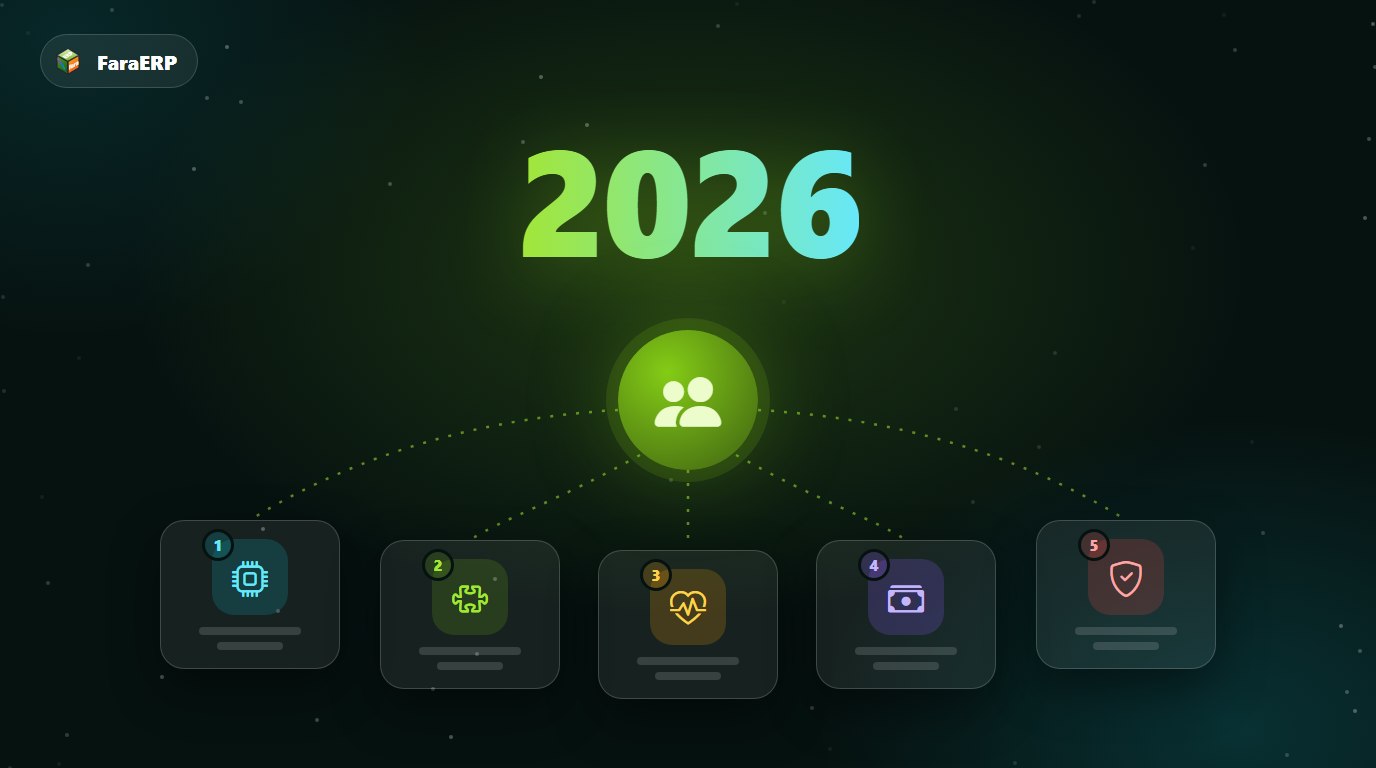
At a glance
- AI is HR leaders’ top priority in 2026 — but without clean employee data there is nothing to automate.
- Workforce planning has moved from "how many people" to "which skills, where and when".
- Global engagement has hit its lowest level since 2020, and most of the drop started with managers themselves.
- Pay transparency is now law in Europe, and its logic — pay you can explain — holds for any organisation.
- Tools that shape hiring, appraisal and monitoring decisions are classed as "high risk" and need an auditable trail.
1. AI has entered day-to-day HR
In Gartner’s survey for 2026, AI transformation tops the list of CHRO priorities. Gartner predicts that by 2030 half of today’s HR tasks will be automated or handled by AI agents, and the share of organisations piloting or deploying generative AI rose from 19% to 61% in two years.
What those headlines rarely say is that AI runs on data. If leave balances live in a spreadsheet, contracts in a paper folder and hours worked in the time clock’s own software, no agent can answer a simple question like "who went over the overtime cap this month?". The first step of AI in HR is integrating the data.
2. Workforce planning: from headcount to skills
Gartner’s second priority is redesigning the workforce for an era of humans working alongside machines: strategies that cover today’s needs and tomorrow’s. Organisations look less at degrees and more at proven skills, and they connect learning, internal mobility and performance.
In practice, a manager needs to know who has been trained in what, whose certificate is about to expire and which shift is short of skilled people — and those answers should come from one place, not three files.
3. The middle manager is the engagement bottleneck
Gallup’s State of the Global Workplace 2026 report shows that only 20% of employees worldwide were engaged in 2025, the lowest level since 2020. Gallup puts the cost at around $10 trillion in lost productivity and attributes most of the decline to managers, whose own engagement has fallen nine points since 2022.
A large part of a middle manager’s week goes on repetitive admin: signing leave forms, chasing travel requests, collecting hours for payroll. Every hour freed from that is an hour that can go into talking with the team.
4. Pay transparency: pay you can explain
The EU Pay Transparency Directive (2023/970) was due to be written into member states’ law by 7 June 2026. Under it, employers must state the pay range before the interview and may not ask candidates about their previous pay, and employees may ask for their own pay level and the average pay of colleagues doing equal work. Gender pay gap reporting starts in 2027 for organisations with 250 or more staff. Most countries have missed the deadline; the Netherlands, for example, has postponed implementation to 1 January 2027.
Even outside Europe the logic is sound: if you cannot explain why someone’s payslip shows that figure, you will lose trust sooner or later. Pay should come from documented rules, not from a calculation file only one person understands.
5. Governance of algorithmic decisions
The EU AI Act treats tools used in recruitment, selection, performance evaluation, task allocation and employee monitoring as "high risk". The Digital Omnibus agreement of May 2026 pushed the deadline for those obligations back to 2 December 2027, but the direction is clear: decisions about people need an auditable trail and a human who answers for them.
What all five have in common
None of these trends is solved by buying one more standalone tool. They share one prerequisite: people data that sits in one place, is current and can be trusted, and is the same data that payroll and accounting use — not data reconciled with them every month.
How the FaraERP HR module helps
The FaraERP HR module runs on the same database as accounting, payroll and office automation. Below, each trend is mapped to what the system does today.
One file per person — the basis of any automation
Employee records, employment contracts, work history, dependants and personnel actions — hire, appointment, promotion, transfer, salary change, contract renewal, suspension and termination — are kept in one place. An issued action is locked, and correcting it means cancelling and reissuing, so the history is never erased. That structured data is what any later automation, from a simple report to an AI assistant, depends on.
Shifts and hours worked: workforce planning day by day
Shift rosters are generated automatically and respect the rules: minimum rest between shifts, a weekly hours cap, weekly days off and a fair spread of night and holiday shifts. Shift swaps go through approval. Actual hours are compared with the plan — late arrival, early leave, absence, overtime and night work — and time-clock exports (Excel, CSV or text files such as ATTLOG) are imported through a template defined per device model.
Approval inbox and dashboard: giving managers their time back
Full-day and hourly leave, business travel and overtime are requested in the panel and approved through workflows with configurable stages; the approver can be the direct manager taken from the org chart, and notifications go out by SMS. The HR dashboard shows headcount, people on leave or travelling, pending requests, contracts ending within 30 or 60 days, 12-month turnover, interviews in the coming week and certificates about to expire.
Appraisal, training and recruitment: one continuous path for skills
Performance appraisals use templates with weighted criteria and run in defined cycles: self-assessment, review by the direct manager, finalisation and the employee’s comment. Training courses (including mandatory ones), sessions, participants and certificates with expiry dates are recorded, with a compliance report for mandatory training. In recruitment, every applicant is tracked from application through screening, interview, assessment and offer to hire — and pressing "Hire" creates the employee record and a draft hiring action, with no retyping.
Transparent, explainable payroll
Approved leave, travel, overtime and shifts become the month’s payroll inputs, with a preview first. The payroll engine builds pay items from defined formulas, calculates social-security contributions and income tax, and keeps a calculation trace for every payslip, so you can show exactly where each figure came from. Employees see their own payslips, appraisals and training in the panel; with the office automation module they also see their leave balance and travel there. For moving from a previous system there is a "compare" mode: a few months are calculated in both systems and differences are visible before the switch.
Governance and security of employee data
Access is role-based — HR manager, manager, supervisor — and nobody can grant anyone a role above their own. Each customer’s data sits in its own separate database — the companies of one holding share a database, with access defined per company — and if needed the whole system can be installed on the organisation’s own server.
An AI assistant, with a person in charge
The FaraERP HR module now has an AI assistant. It suggests drafts and analyses in day-to-day HR work, so that repetitive work shrinks and more time is left for the people themselves. We built it on the principle described in trend 5: the assistant makes no decision about anyone, and no suggestion reaches a record without a person approving it. To read a CV, the CV file itself is given to the assistant, so this is switched on only when the organisation decides to. Every suggestion is logged together with what the user did with it, so it can be reviewed later. The assistant is off by default; each organisation decides whether to turn it on. We show the details in a demo.
What you should honestly know
The AI assistant suggests; it does not decide. Automatically scoring or ranking people, or selecting candidates, is deliberately not part of what it does, and its suggestions are only as good as the integrated data described above. Time-clock data is imported today from the device’s export file; a direct device connection is being rolled out. Requests are made in the web panel, which works on a phone, and are not yet in the mobile app. The statutory insurance and tax lists are generated from the same calculation, and with the accounting module the payroll voucher is posted — and reversed if needed — with one button. The HR module is licensed separately and only costs you something if you want it.
A 90-day roadmap
- Days 1–30: bring employee files and contracts into one clean place, and set each person’s direct manager in the org chart.
- Days 31–60: define approval workflows for leave, travel and overtime, connect the time-clock export and generate shifts from rules.
- Days 61–90: run one or two months of payroll in compare mode, open the first appraisal cycle and record mandatory training.
Sources
- Gartner — Top HR Trends and CHRO Priorities for 2026
- Gallup — State of the Global Workplace 2026
- Debevoise & Plimpton — The EU Pay Transparency Directive: what it means for employers
- PwC Netherlands — EU Pay Transparency: Dutch implementation delayed to 2027
- DLA Piper — The Digital AI Omnibus: deferral of high-risk AI obligations
Frequently asked questions
What does the FaraERP HR module include?
Employee files and contracts, personnel actions, leave, travel and overtime with approval workflows, shifts and hours worked, time-clock file import, payroll, performance appraisal, staff training, recruitment, an HR dashboard and an optional AI assistant — all on one database.
Can time-clock data be imported into FaraERP?
Yes, from the device’s export file (Excel, CSV or a text file such as ATTLOG), using a template defined per device model. A direct connection to the device is being rolled out.
Can we compare payroll before switching off our current system?
Yes. In compare mode a few months of payroll are calculated both in FaraERP and in the previous system, so differences are visible before the final switch.
Is the HR module sold separately?
Yes. HR is a separate module and is only switched on on your server once you have bought it.
Does FaraERP use AI in HR?
Yes. The HR module has an AI assistant that suggests drafts and analyses in day-to-day work. A person always makes the decision, personal identifiers are removed before analysis, and the assistant stays off until the organisation itself turns it on.