
The Clinic That Runs Itself: FaraClinic, From the First Booking to the Last Journal Entry
It’s eight in the morning. The reception phone won’t stop ringing, the appointment book is a mess of crossings-out, three patients ask at once “when is it my turn?”, and dozens of bank-transfer receipts wait in the clinic’s WhatsApp to be checked. At night the cash desk doesn’t match the bank, and the accountant has to enter everything again. Sound familiar?
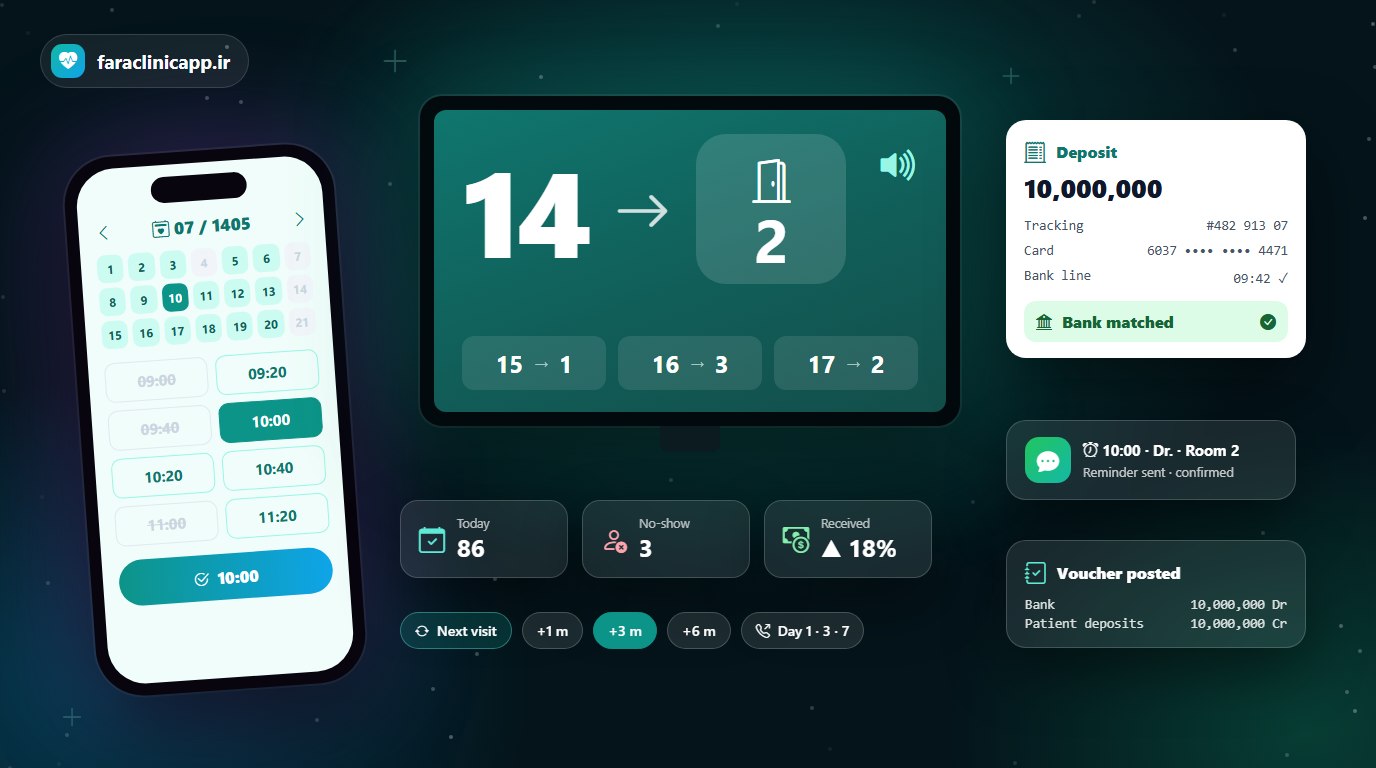
FaraClinic was built to end exactly that chaos: clinic management software built on FaraERP that connects booking, deposits, reception, the queue and waiting-room display, the cash desk, bank reconciliation and accounting. Whatever reception records reaches the cash desk and the books without anyone typing it again.
At a glance
- Online, phone and walk-in booking that follows your clinic’s own rules.
- Bank-transfer deposits whose receipts are checked by AI.
- A waiting-room display that calls patients by name and room number, out loud.
- Automatic matching of receipts against the bank statement; a journal entry only after the bank and the cashier confirm.
- The next visit booked in two clicks by the doctor, plus follow-up after treatment.
- All on one database, alongside FaraERP’s accounting, inventory, HR and management dashboard.
One patient, ten stations, zero re-entry
FaraClinic’s real power is that everything is connected. Follow one patient from the first call to the journal entry:
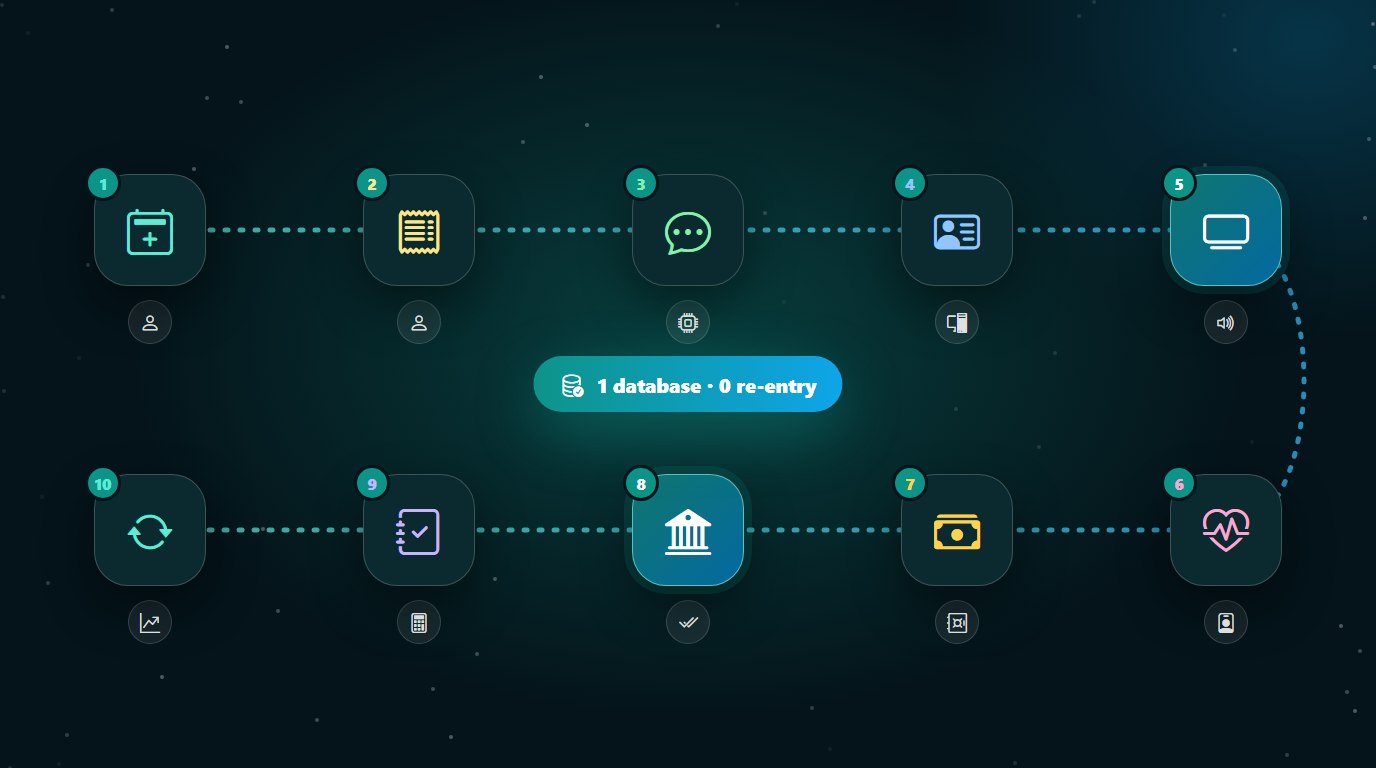
- Booking: the patient books on the clinic’s website, the booking marketplace, by phone or in person.
- Deposit: they pay by bank transfer and upload a photo of the receipt.
- Message: the booking confirmation and reminder reach them automatically.
- Reception: a file is opened and several services are recorded in one admission.
- Queue: the waiting-room display calls them to the room, with voice.
- Doctor: records a new service or the next visit right there.
- Cash desk: payment is recorded as cash, card terminal or bank transfer.
- Bank: the receipt is matched against the bank statement.
- Journal entry: accounting posts it without retyping anything.
- Follow-up: in the days after treatment, calls and outcomes are logged in the file.
1. Booking that knows your rules
You define a separate policy for each branch, service or doctor: fixed-time slots or queue numbers, slot length, gaps between appointments, each doctor’s daily cap, the cancellation window and official holidays. The system only offers times that fit those rules and holds the chosen time until it is confirmed — two bookings in one slot? Never again. The clinic can also have a showcase on the booking marketplace book.clinicpanel.ir.
2. Deposits without fake receipts
A no-show means an empty hour for the doctor. Deposits solve that — as long as the receipts are real. In FaraClinic the patient uploads a photo of the receipt, and AI flags a short amount, the wrong destination card or a duplicate receipt and notifies the approver. If you prefer, a payment gateway can be connected too.
3. A calmer waiting room
Instead of asking the receptionist again and again, patients see and hear their number and room on the TV. Reception or the doctor calls the patient, the display updates instantly and the call is read out in a female or male voice. To create the voice, only the name, gender and room number are sent — nothing more.
4. The doctor, in two clicks
The doctor’s time is the clinic’s most expensive resource. If another service is needed, the request appears on the reception screen at once with a payment button — no slips of paper, no running around. The patient’s next visit — one, two, three or six months later — is booked in two clicks from the queue page, and reception fine-tunes the exact time later. Every service has default consumables, and any extra is added to the bill automatically.
5. The money you count is the money that reached the bank
This is where FaraClinic really shines. The bank statement is imported as CSV or Excel, and each receipt is matched in one of three ways: the tracking number, the card digits plus the time, or the payer’s name plus the time. Receipts with no deposit behind them and deposits nobody declared are flagged separately. And the golden rule: a deposit is posted only after it matches the bank and the cashier confirms it.
6. Accounting without re-entry, a manager without the phone
A ready-made clinic chart of accounts, automatic revenue entries when a service is delivered and a simple accounting mode make life easy even for small practices. Without calling reception, the manager sees how many appointments there are today, how many patients didn’t show and how much was received — and, with a data logger, the live temperature and humidity of the medicine fridge. Inventory with batch and expiry dates, purchasing with AI-read invoices, HR and payroll live in the same system.
7. Patients aren’t forgotten once they leave
For each service you set when follow-up happens — say on day 1, 3 and 7 — and the outcome of each call, the satisfaction score and any complication stay in the file. A reminder for the next visit brings the patient back to the clinic.
Which centres is it for?
- Specialist clinics and private practices: booking, deposits, messages, several services in one admission and the next visit.
- Day clinics and multi-doctor centres: a separate queue for each room, prices by the doctor’s grade and a cash desk that totals each payment method separately.
- Hospitals: reception, queue and cash desk for outpatient and paraclinical departments, inpatient wards with beds, discharge and nightly charges, plus every support unit.
- Veterinary clinics: the owner is the client, and every animal has its own record: visits, vaccinations with their next due date, allergies and hospital stays.
Few claims, real work: insurance and e-prescriptions, laboratory and imaging are not in FaraClinic today, and we don’t claim them. What it does is already part of the daily work of Dr Shafiee’s heart clinic, and its rollout at Dr Ladan Parsa’s skin and beauty clinic has started with the deposit and bank-reconciliation flow.
Your data, on your own instance
Each centre has its own separate instance and database, on the centre’s own server or on ours. The data belongs to your centre and is never mixed with any other centre’s.
From the first conversation to the first working day
- A conversation and a demo built on your centre’s current workflow.
- Installation of your own instance, with only the parts you need switched on.
- Setting up branches, rooms, doctors, services, prices and message texts.
- Training for each role: reception, cash desk, doctor, accounting and management.
- Go-live, with us at your side in the first days.
Your clinic exists to treat patients, not to keep ledgers. Let FaraClinic run the rest. See FaraClinic with your own centre’s scenario.