
The Garage That Never Forgets the Mileage, the Part or the Pick-Up Time: FaraERP Service Management for Car Repair Shops
It’s Saturday morning. Five cars are queued at the door, the paper job cards on the desk are covered in oil, and a customer swears the mileage was lower when they dropped the car off. One unrecorded number is enough to turn a working day into arguments and bad feeling.
FaraERP’s service management has a dedicated car-repair profile: every vehicle has its own identity, and whatever was said and handed over at the counter is recorded on the spot.
At a glance
- Every car booked in by make, model and number plate, under its owner.
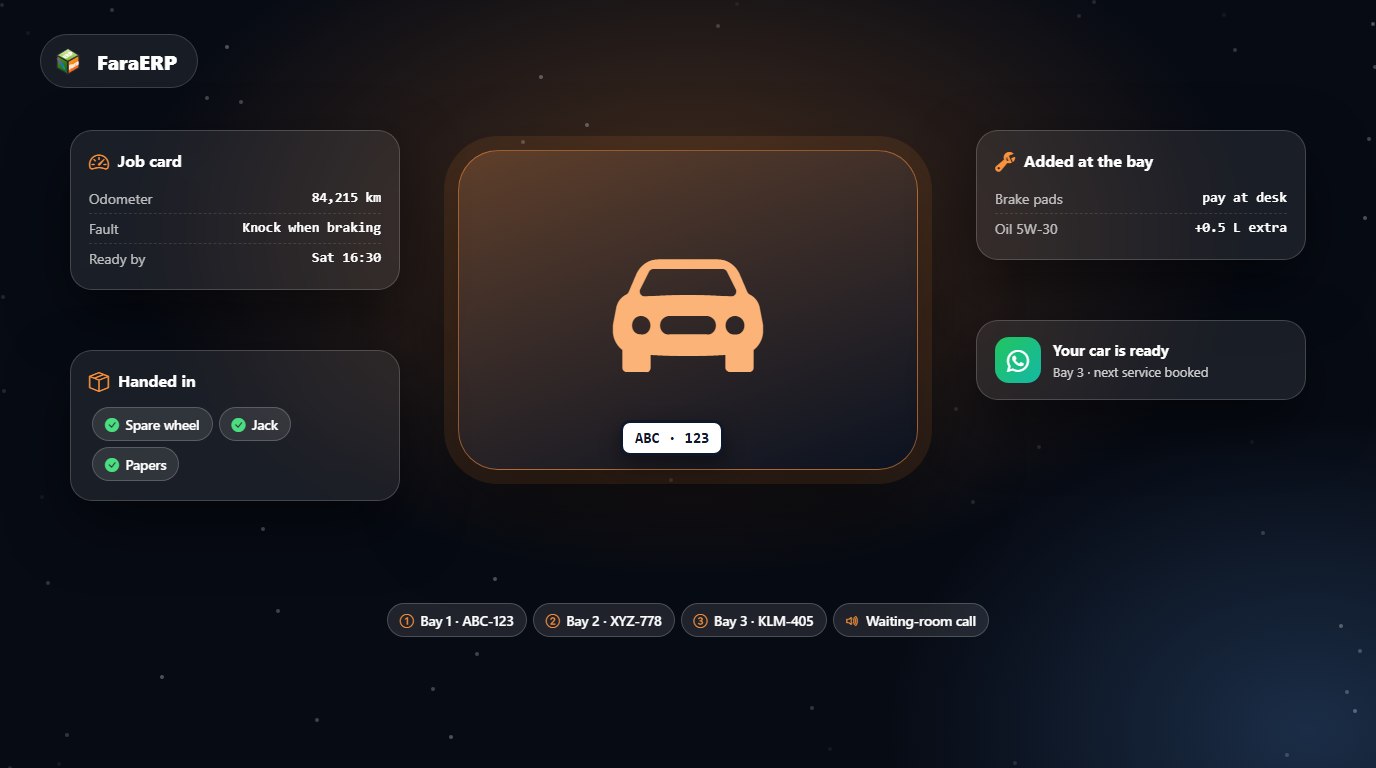
- Mileage at intake, the fault in the customer’s words, accessories and an estimated ready-by time.
- A “your car is ready” message by WhatsApp or SMS.
- Bay queues, parts and consumables that add up, a cash desk and receipts.
Every car, a file
Customers are found by phone number, and their cars — with make, model and plate — are registered under their name. A company fleet or a family’s two cars each get their own intake and history; the next time the same plate comes in, you know what was done last time.
A job card that leaves no room for argument
- Mileage at intake: the odometer reading is recorded on the spot; nobody argues about it later.
- The fault in the customer’s words: “a knocking noise from the front when braking” — exactly as it was said.
- Accessories handed in: spare wheel, jack, removable stereo or registration papers; whatever you took in is on record.
- Estimated ready-by time: the customer knows from the start when to come back.
Bays, mechanics and a waiting-room voice
Each bay has its own queue, and the customer is called with one click, with the waiting-room TV announcing them too. If the mechanic finds more work at the bay — pads, a belt or an oil change — they record the service and it lands on the reception screen at once with a payment button. Parts and consumables have default quantities per service, and anything extra is added to the bill automatically.
“Your car is ready”
When the job is done, the system messages the customer — WhatsApp first and SMS if that doesn’t arrive — automatically if the branch wants, or with one click at reception. And if the car is due a periodic service in a few months, you book its next visit right there and reception agrees the exact time with the customer.
The shared backbone: from booking to the books
Underneath these specialist features runs the same engine that makes FaraERP’s service management dependable for any service business:
- Booking on your own rules: a separate policy per branch, service and mechanic — slot length, capacity, daily caps and an SMS booking confirmation.
- Queue and waiting-room display: one “call” sends the customer to the bay, and the waiting-room TV calls them out.
- Extra work without paperwork: a service the mechanic adds appears instantly on the reception screen with a payment button.
- Consumables that add up: each service has default consumables and an “included” quantity; anything beyond it is added to the bill automatically at the excess rate.
- Cash desk and receipts: cash, card terminal and bank transfer, with refunds and voids; printed receipts at 80 or 58 mm or A5, with your name and logo.
- Receipts matched to the bank: card-transfer receipts are matched against the bank statement; receipts with no deposit and deposits with no receipt are flagged separately.
- Customers who come back: admissions can enrol the customer in the CRM automatically, so targeted campaigns — say, everyone who hasn’t been in for a while — can invite them back.
- A manager’s dashboard: unique, new and returning customers, average revenue per customer, and each mechanic’s output.
- The rest of FaraERP on the same database: accounting, inventory, purchasing, HR and payroll — with no re-entry.
Your garage exists to serve, not to keep books. Let FaraERP’s service management run the rest — to see it with your own business’s scenario, the demo button is right below.