
ERP for Construction and Contracting Companies: Don't Count Modules, Ask These 10 Questions in the Demo

A few days ago we received a note an evaluator had written while assessing FaraERP. In short: "Not all of these 39 items are classic ERP modules. For a developer or construction company, the project management module and how it links to accounting, purchasing and stores matter more than the total number of modules."
We agree. A module count does not show depth. And their second point was fair too: our public description of projects only mentioned phases, tasks, timesheets and budgets, and said nothing about what contractors and employers actually live with. This article is our answer.
Why module count is a poor yardstick
An academy, a hotel desk or a content system can be valuable to some businesses, but none of them decides anything for a construction company. Its key question is: can we see the money and the progress of each project correctly, in one place, from contract to ledger? If not, another hundred modules will not help.
A ten-question checklist for a construction ERP demo
Ask these in any vendor demo, with data from one of your own projects. FaraERP's answers follow each question:
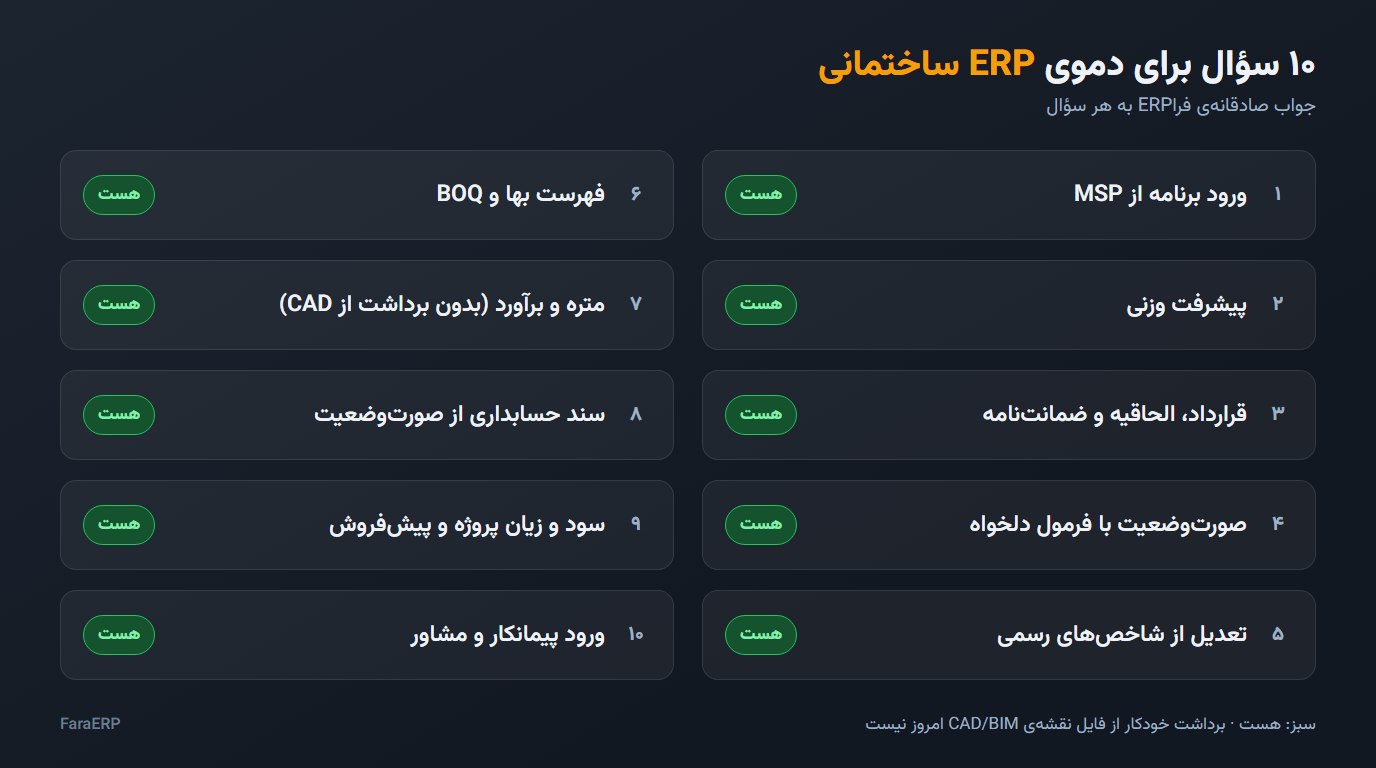
- 1. Does it import the schedule from MS Project? Yes. An MS Project file saved as XML comes in with its work breakdown, links and amounts, and dates are calculated on the critical path. Excel or manual entry also work.
- 2. Is progress weighted, or just "task percent"? Weighted. Each activity's progress rolls up to the contract and project by the weight of its amount or quantity.
- 3. Does it know contract types? Yes: unit-price (quantity × rate), lump-sum and cost-plus, with amendments and bid, performance, advance and retention guarantees.
- 4. Are payment certificates built on your own formula? Yes. The work-done basis and formula lines are configurable: advance recovery, retention, insurance, tax, VAT, penalties, materials, price adjustment and more. The contractor's own Excel certificate can be read in.
- 5. Is price adjustment calculated? Yes. Official quarterly indices (per trade and rate-list chapter, plus the general index) are entered once, by hand or from Excel in the published table layout. Each contract gets a trade, a base quarter and a factor (default 0.95), and a price-adjustment-from-index line adjusts each chapter's work for the period automatically. The breakdown per chapter stays with the certificate, a provisional adjustment uses the latest index when the period's index is not yet published, negative adjustments count too, and the line posts to accounting like the others.
- 6. Is the bill of quantities controlled? In a unit-price contract, work done is calculated from each line's quantity and rate, and progress is visible per line.
- 7. Does it do quantity take-off and estimating? Yes, with one honest no. The rate list is imported from Excel and each project's estimate is built from rate-list items or starred items. Each item's measurement rows (count × length × width × height × factor, with deduction rows such as openings) refer to the project's drawings; chapter totals and shares, overhead and regional factors are calculated and the estimate is compared with contract amounts. What is not there: automatic take-off from CAD/BIM files; measurements are entered row by row and the system calculates.
- 8. Do certificates post to accounting? Yes. After the approval chain an accounting voucher is posted automatically, each formula line to its own account. Accounting, purchasing and stores documents carry project, phase and cost-centre tags.
- 9. Can you see each project's profit? Yes. Developers get a pre-sale module: units by block, floor, area and price, pre-sale contracts with instalment schedules up to key handover, buyer receipts through treasury, arrears, handover and cancellation. A project P&L page shows sales and collections, cost to date, estimated total cost and forecast profit and margin; the P&L statement comes from project-tagged ledger entries, and pre-sale revenue is recognised by percentage of completion with automatic vouchers.
- 10. Can contractors and consultants log in? Yes, with access limited to their project: daily site reports, drawings with revisions and transmittals, and issues, risks, RFIs, non-conformances, claims and meetings with follow-up and escalation.
Links to accounting, purchasing and stores: where ERP differs from project control
A project-control tool can draw a nice Gantt chart. An ERP earns its place in a construction company when the rebar issued from the store, the supplier's invoice and the certificate paid to the contractor all land on the same project and phase. In FaraERP certificates post vouchers, and purchasing, stores and accounting all carry the project dimension. A portfolio page puts progress, earned value and the forecast of coming certificates for every project side by side. For developers, a 12-month cash flow per project is shown too: inflows from pre-sale instalments, outflows from forecast contractor certificates.

How to run the demo
- Use your own project: bring the MS Project file of a real contract and a contractor's Excel certificate.
- From contract to voucher: ask for one certificate to be built in front of you, all the way to the accounting voucher.
- From store to project: issue materials to site and see which project and phase the cost lands on.
- Through the contractor's eyes: log in as the contractor and see what they can and cannot see.
- Ask for the noes: a vendor who says yes to every question probably did not hear them properly.
Honestly: automatic quantity take-off from CAD or BIM files is not in FaraERP; measurements are entered row by row. The contract-projects module is switched on separately.
Thanks to the evaluator who asked these questions. If you are evaluating an ERP for construction projects, read our ERP demo guide and request a demo; we will go through these ten questions together.