
How Does Satellite-to-Phone Internet Work? A Simple Explanation
The dream of always being connected — from mountains to deserts
Imagine you are travelling deep in the desert, or you have gone hiking in a remote mountain range, and suddenly you notice your phone has no signal at all. It has happened to many of us. In a world where everything we do is tied to the internet, losing contact for even a few hours can be worrying. Ordinary cell towers only cover a limited area, and building them in forests, oceans or on mountain peaks is practically impossible.
This is where the exciting idea of connecting mobile phones directly to satellites comes in. This innovative technology aims to push the limits of communication so that no spot on Earth is left without network coverage. Put simply, instead of your phone looking for a tower on the ground, it connects directly to satellites moving across the sky.
Bringing this technology into everyday life could make a big difference. Here are some of the most important changes:
- Access in tough conditions: on mountain roads or hard-to-reach routes, you will no longer have to worry about getting lost or being cut off from your loved ones.
- Faster rescue: when natural disasters such as earthquakes or floods damage ground towers, satellite links can save lives.
- An end to dead zones: you can travel to the most untouched corners of nature without worrying about losing internet or calls.
This young technology is set to become a normal part of our lives soon. In the sections below we look at how the system works, and how it connects the ordinary phone in your pocket to space without any extra equipment.
How exactly does satellite-to-phone internet work?
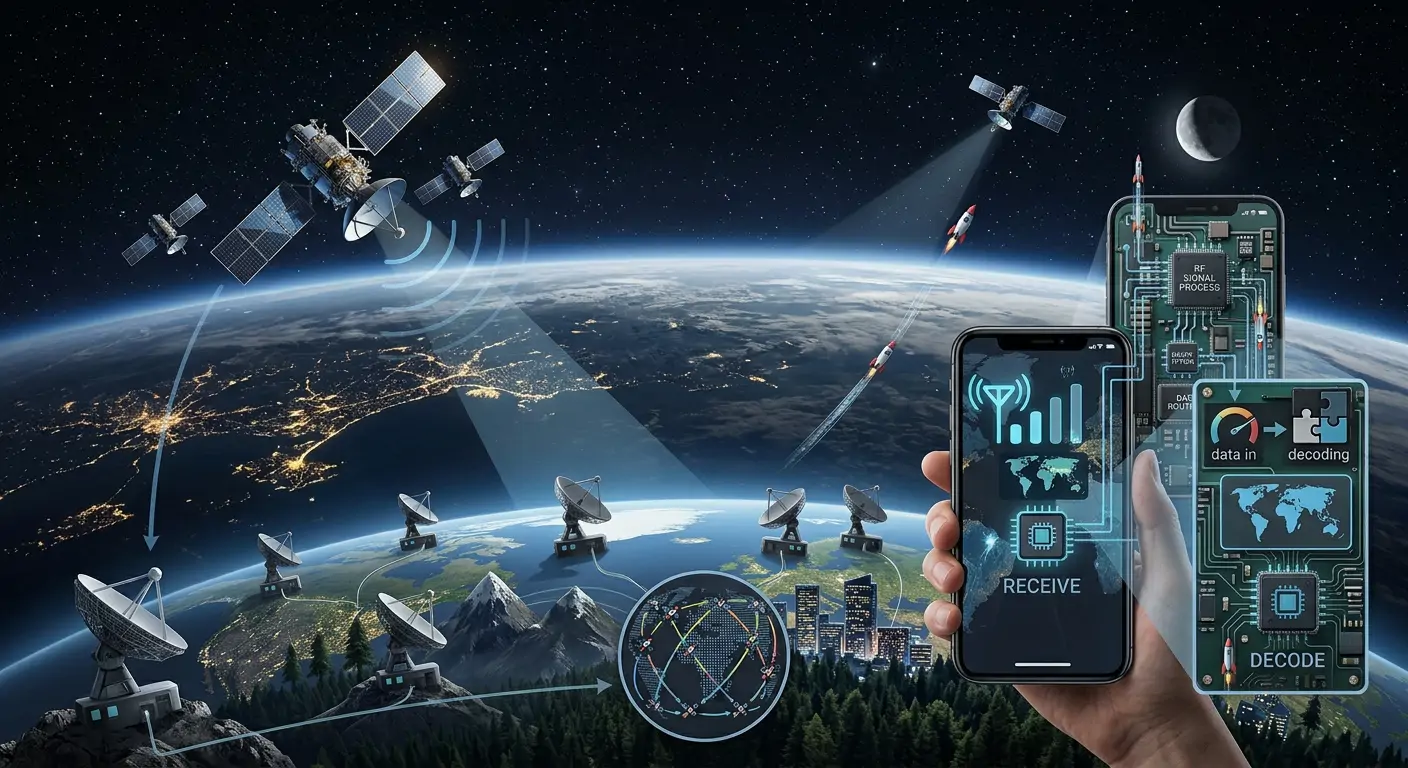
You may wonder how an ordinary phone, which needs ground towers to work, can suddenly talk to a satellite in space. The answer is much simpler than you might think. In this new system, highly advanced satellites have been placed in low Earth orbit, where they act like flying, moving cell towers.
These satellites are close enough to Earth to pick up the weak signals of mobile phones. When you press “send” on a message in a remote area, your phone sends the signal straight up to the sky. Without any dish or extra equipment, the signal is caught by one of these flying towers in space.
But that is not the end of the story. A satellite alone cannot connect you to the whole internet. This is where large ground stations come into play. The process works like this:
- The phone sends the signal: your message goes to the nearest satellite overhead.
- Relay to a ground station: the satellite quickly passes the signal on to an equipped station on the ground.
- Connection to the global network: the ground station connects the data to the main internet and sends the reply back to your phone along the same path.
This whole long journey to space and back takes only a few seconds. So, without ever noticing the technical complexity, you can easily stay in touch with others from the most remote places on Earth.
Why don’t we need special equipment?
You may ask how the ordinary phone in your pocket can connect to a satellite thousands of kilometres above without a big dish or heavy equipment. In the past, satellite internet meant installing special equipment, large dishes on the roof and carefully aligning them. The new technology has changed all of that and made everything simpler than ever.
The secret lies in the evolution of the built-in antennas of today’s phones and the frequencies the satellites transmit on. The new satellites carry very advanced, sensitive antennas that can pick up even the weak signals of ordinary phones. In fact, the frequencies they transmit on are matched to the same bands mobile operators use around the world.
For the system to work smoothly, major partnerships have formed between different players:
- Partnerships with operators: instead of competing with mobile operators, satellite companies team up with them to use their existing, licensed frequencies.
- Software support: smartphone makers use software updates to prepare the phone’s chips to recognise these space-borne frequencies.
- No hardware changes: you do not need to buy a new phone or add any part; your current phone has the potential to make this connection.
Put simply, the new satellites work like extremely tall cell towers floating in the sky that speak your phone’s language perfectly. This remarkable compatibility means that, in the near future, you will be able to stay connected without the hassle and cost of buying bulky equipment.
How is satellite internet different from regular mobile internet?
You might ask: if satellite internet is coming to our phones, why do we still need cell towers in the city? The truth is that satellite mobile internet differs fundamentally from the fast mobile internet we use every day. For now, the speed and latency (ping) of urban 4G and 5G networks are much better than satellite links. Ground towers are very close to us, so they move data in a fraction of a second, while a satellite signal has to travel much farther, up to orbit and back.
That is why, in the first phases of this technology, we should not expect to stream high-quality films or play online games without lag. The bandwidth of direct satellite-to-phone internet is currently limited. The system is mainly designed for emergency text messages, essential calls in a crisis and light tasks, so that nobody anywhere in the world is left without a connection.
We also have to pay attention to the environment. Unlike regular internet, which works easily indoors, satellite internet needs a clear view of the sky. The following can reduce the quality of the connection:
- Building roofs: concrete and building materials block weak satellite signals.
- Dense vegetation: very tall trees and thick forests can weaken the signal.
- Bad weather: very thick clouds or heavy rain sometimes affect data transmission.
So this new technology is not meant to replace fast urban internet. It sits alongside it as a lifesaving backup that keeps us connected to the world when ordinary towers are out of reach.
When will everyone have this technology?
You may wonder when this fascinating technology will be available to all of us. The truth is that we are already at the start of this exciting journey. Some of the world’s largest space and telecom companies have completed successful tests, sending and receiving text messages via satellite to ordinary phones on the ground. In other words, the technical foundation is ready; it is no longer a distant dream.
Of course, the technology will grow step by step. In the first phase the focus is mostly on short and emergency text messages. But plans show that, in the very near future, voice calls and even fast internet for browsing and downloading will be added. The big companies keep launching more satellites into orbit to make the network’s coverage more complete and stronger.
Despite the rapid technical progress, another important piece still has to be solved: legal challenges and international agreements. Because radio frequencies know no borders, satellite companies must reach agreements with the governments and local operators of each country. This coordination is necessary to prevent interference and comply with each country’s laws, and it makes nationwide activation take some time.
The future of communication in your hands
Imagine you have had an accident in the farthest corner of a desert or among the rocks of a rugged mountain, and you need help. In the past, having no mobile signal in that situation could cost a life. Now, with satellite internet coming to ordinary phones, that worry disappears for good. First and foremost, this technology is a guardian angel for emergencies: in a crisis such as a flood, an earthquake or getting lost in nature, it can keep you connected to the outside world.
We are moving towards a world in which the term “dead zone” will no longer mean anything. Whether you are in the middle of the ocean, standing on a high mountain peak or crossing a deserted desert road, the sky above you will always be full of flying cell towers ready to carry your voice to the world. This big change moves the boundaries of traditional communication and brings connectivity to everyone, fairly.
To keep up and be among the first to use this amazing technology, we suggest the following:
- Follow news about partnerships between your local operators and satellite companies, so you know when the service is switched on in your area.
- When buying a new phone, check its specifications and ask whether it supports direct satellite connectivity.
- Check your current phone’s manual or settings; your phone may already have the basic hardware for sending emergency messages via satellite.
The future of communication will be far more exciting than today. By following this young technology, get ready for a world without borders that is always connected.